Call us now :08045802246
 Send Inquiry
 Send Inquiry
Research Polarizing Microscope
Price 22000 INR/ Piece
MOQ : 1 Piece
Research Polarizing Microscope Specification
- Features
- Rotatable stage, polarizer & analyzer, Bertrand lens, compensator slots, strain-free optics, trinocular head
- Focus System
- Coaxial coarse and fine focusing knobs, tension adjustable
- View Head
- Trinocular; 360° rotatable with sliding interpupillary adjustment
- Spare Parts
- Replacement bulbs, fuses, eyepieces, objectives available
- Theory
- Polarized Light Microscopy for optical mineralogy, geology, and material science analysis.
- Drawtube
- Trinocular, 45° inclined, 360° rotatable
- Sensor
- Not Applicable (Optical only, digital camera optional)
- Resolution
- Optical; depends on objectives (up to 1000x with standard objectives)
- Interface
- Standard optical; trinocular for digital camera attachment possible
- Frame Rate
- Depends on camera (optional attachment)
- Focal Distance
- 160 mm (Mechanical tube length)
- Magnification
- 40x to 1000x (using 4x, 10x, 40x, 100x objective lenses with 10x eyepiece)
- Dimensions
- Approx. 475 mm (height) x 245 mm (width) x 355 mm (depth)
- Focus Range
- Coarse and fine focusing, approximately 30 mm travel
- Eyepieces
- WF10x/18mm with diopter adjustment
- Eyepiece Tube
- Interpupillary distance adjustable from 55 - 75 mm
- Illumination
- Transmitted Koehler illumination (Halogen 6V/20W or LED equivalent)
- Coarse Adjustment Range
- 30 mm
- Fine Adjustment Range
- 0.002 mm precision
- Working Stage
- Rotatable circular stage, 360° graduated, 150 mm diameter, vernier scale
- Still Image Capture Resolution
- Depends on camera; up to 5 MP (with optional camera)
- Video Capture Resolution
- Depends on camera (optional digital module)
- Image Format
- Available with optional digital camera attachment (JPG, BMP, etc.)
- Interpupillary Distance
- 55-75 mm adjustable
- Objective Achromatic
- 4x, 10x, 40x (S), 100x (Oil), PLAN Achromatic objectives
- Condenser
- Abbe N.A. 1.25 with iris diaphragm and swing-out polarizer
- Light Source
- Halogen lamp 6V/20W or LED multiple intensity with external power supply
- Polarizing Accessories
- Built-in rotatable polarizer (below condenser), analyzer in slide-in/out mount, accessory slot for compensators (, 1/4 plate, quartz wedge)
- Dust Cover
- Supplied for safe storage
- Nosepiece
- Reversed quintuple (5-position) ball-bearing nosepiece
- Bertrand Lens
- Centerable, focusable for conoscopic observation
- Power Supply
- AC 220V/110V selectable
- Mechanical Stage Movement
- Stage vernier precision to 0.1 for angular measurement
- Transmitted Light Path
- Koehler illumination system for uniform light field
- Environmental Conditions
- Operating temperature 10C-40C, max relative humidity 80%
About Research Polarizing Microscope
Research Polarizing Microscope
Focusing - Coaxial focusing is provided with coarse tension adjustment ring and graduated slow motion knobs. Adjustable safety lock is attached to prevent the breakage of specimen slides.
Illuminator - Koehler's Illuminator with pre-centered 20W Tungsten Halogen source & integral
Electric transformer with intensity control.Input voltage 220or110v.
Intermediate Tube - Built-in focusable Bertrand Lens with center adjustment. Built-in Analyzer removable from optical part. Analyzer can be rotated 90° with venire reading to Compensator 1 Lambda, 1/4 Lambda & Quartz Wedge can be inserted in the tube as per requirement. Compensator - Gypsum (1st. order red compensating plate, 560nm). Mica (145nm) & Quartz
Wedge(I-IV order).
Objectives - Stress less flat achromatic DIN Objectives PF4x/0.10, PF10x/0.25 & PF40x/0.65 SL Eyepieces - HKW10x Paired & WF 10x Cross
Polarizer - Fully rotatable Polarizer on a strain free N.A 1.25 abbe condenser with iris diaphragm. Optional Accessories - Detachable Mechanical Stage, Objectives PF20x & PF60X, Micrometer Eyepiece WF10x, Microphotography Equipment, 30º Inclined Siedentopf Heads. Wooden storing cabinet etc.
Research Polarizing Microscope is principal piece of equipment used by the Geologists to observe the optical properties of minerals. It has indispensable applications for petrography, crystallography, geology, mineralogy, ceramics, toxicology, chemical microscopy or detecting defects in semi-conductors, finding stress points in metals, glass & textiles etc
Stage - Compact Ball bearing Rotating Stage, 140mm dia., graduation with vernier, lock & stage specimen clips.
Advanced Polarized Light Microscopy
This microscope utilizes optimized polarized light for distinguishing optical characteristics in minerals, crystals, and biological specimens. The built-in polarizer, analyzer, and accessory slots accommodate a wide array of compensators, ensuring flexibility for various analytical tasks. Researchers benefit from a precise, rotatable stage and vernier for angular measurements, complemented by high-resolution optics for reliable image quality.
Reliable Construction and Versatile Operation
With a robust, metal frame, tension-adjustable focus, and interchangeable halogen or LED light source, the microscope promises longevity and adaptability. The trinocular, 360 rotatable head offers comfort during extended sessions and seamless integration of a digital camera (optional) for documentation or collaborative analysis. Compatible with standard AC power, its engineered for reliable operation in laboratory environments.
FAQs of Research Polarizing Microscope:
Q: How do I use the built-in polarizer and analyzer for polarized light observations?
A: To perform polarized light observations, rotate the built-in polarizer (located below the condenser) to align with the desired angle. Slide the analyzer into or out of its mount above the objective turret to enhance contrast. This setup enables you to observe birefringence and other optical properties in your specimen.Q: What compensators can I use with this microscope, and what is their benefit?
A: The accessory slot is designed to hold (lambda), 1/4 compensator plates, and a quartz wedge. These compensators enhance your ability to quantify birefringence, measure optical path differences, and precisely determine material properties, which is especially useful in mineralogical and geological investigations.Q: When should I use the Bertrand lens, and how is it adjusted?
A: The centerable, focusable Bertrand lens is essential for conoscopic observation, such as interference figure analysis in crystals. Engage the lens using its dedicated mechanism, and adjust its position and focus to achieve a sharp conoscopic image of the back focal plane of the objective.Q: Where does the microscope get its illumination, and can it be adjusted for specific experiments?
A: Illumination is provided by either a 6V/20W halogen lamp or an equivalent LED, both featuring adjustable brightness. The Koehler illumination system allows precise control of light uniformity and intensity, tailored for various sample types and research requirements.Q: How does the trinocular head enhance research documentation?
A: The 360 rotatable trinocular head makes it easy to switch between visual observation and digital documentation. By attaching an optional digital camera to the third viewing port, users can capture high-resolution still images and videos, facilitating detailed record-keeping and collaborative analysis.Q: What is the process for maintaining and storing this microscope?
A: To maintain optimal performance, routinely clean optical components with lens-safe materials and cover the microscope with the supplied dust cover when not in use. Replacement bulbs, fuses, eyepieces, and objectives are readily available from the supplier, ensuring uninterrupted operation.Q: What are the main usage benefits of this polarizing microscope for researchers and educators?
A: This microscope provides high-precision optical analysis essential for mineral identification, crystal orientation, and material science studies. Its advanced features support both qualitative and quantitative analysis, making it a valuable instrument in research laboratories, universities, and geological survey environments.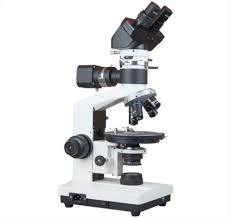
Tell us about your requirement

Price:
Quantity
Select Unit
- 50
- 100
- 200
- 250
- 500
- 1000+
Additional detail
Mobile number
Email

More Products in LABORATORY MICROSCOPE Category
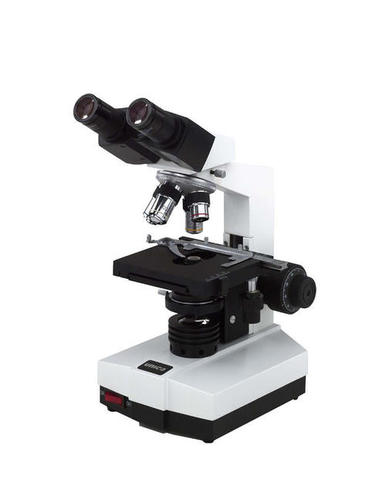
Binocular Co-Xial Microscope
Price 22000.0 INR
Minimum Order Quantity : 1 Piece
Working Stage : Doublelayer mechanical stage with XY movement Square Millimeter (mm2)
Magnification : 40x to 1000x
Theory : Other
View Head : Binocular head with 360 rotation
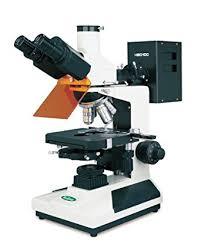
Florescence Trinocular Microscope
Working Stage : Double layer mechanical stage; 135 x 140 mm; XY movement 75 x 50 mm
Magnification : Up to 1000x with standard objectives
Theory : Other, Florescence observation with trinocular head, suitable for biological and pathological research.
View Head : Trinocular (for simultaneous camera and visual observation)
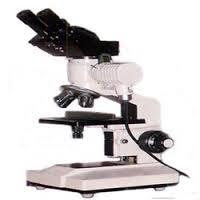
Binocular Metallurgical Microscope
Price 6000 INR / Piece
Minimum Order Quantity : 1 Piece
Working Stage : 175mm x 145mm mechanical stage with slide holder
Magnification : 40x to 1000x
Theory : Binocular optical theory, Other
View Head : Binocular head with 360degree rotation
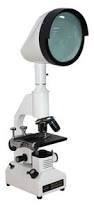
Projection Microscope
Price 6000 INR / Piece
Minimum Order Quantity : 1 Piece
Working Stage : Mechanical stage
Theory : Other, Projection microscope
View Head : Projection screen head

 Send Inquiry
Our Products
- RESEARCH MICROSCOPE
- LABORATORY INSTRUMENTS
- LABORATORY MICROSCOPE
- CHEMISRTY EQUIPMENTS
- OPTICAL BENCHES
- AUTOMATIC PROJECTORS
- HUMAN FIBRE MODELS
- BIOCHEMISTRY EQUIPMENTS
- BIOLOGY LAB EQUIPMENT
- DIGITAL THERMOMETER
- DIGITAL HYDROMETER
- ELECTRONICS ITEMS
- PHYSIOLOGY TESTS
- PHYSIC RESEARCH INSTRUMENTS
- SODA GLASSWARE
- BOROSILICATE GLASSWARE
- PHARMACY EQUIPMENTS & INSTRUMENTS
- Thermometer
- Microscope's Camera
- Microscope's software
- Histopathology
- Operating Microscopes
- Biotechnology Instruments
- Ophthalmic Equipment
- Molecular Biology
- D-Pharmacy Equipment
- Communication Lab Instruments
- Civil Engineering
- Chemistry
- Physics
- tuning fork
- Inverimental
- Hot Air Oven
- Mortuary Chamber

No.-3111/12, Cross Road No. 10, Kacha Bazar, Ambala Cantt - 133001, Haryana, India

Mr Anil Kumar Rana
(Proprietor)
Mobile :08045802246
 Send Inquiry
 Send SMS
 Call Me Free
Developed and Managed by Infocom Network Private Limited.
