
Call us now :08045802246
 Send Inquiry
 Send Inquiry
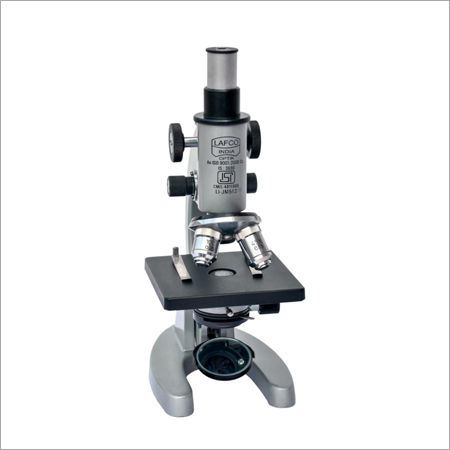
Travelling Microscope ISI
Price 8500 INR/ Piece
MOQ : 1 Piece
Travelling Microscope ISI Specification
- Focus System
- Manual, with coaxial coarse and fine adjustment screws.
- Features
- ISI Marked, non-corrosive metal body, finely finished, precise graduation on scale, horizontal and vertical motion, rigid cast iron base with leveling screws.
- Spare Parts
- Replacement eyepiece, objective lens, glass scale plate, adjustment screws.
- View Head
- Monocular, straight tube.
- Theory
- Used for precise measurement of small lengths by means of a scale and vernier moving horizontally and vertically. Common in laboratories for measuring specimen dimensions or calibrating instruments.
- Drawtube
- Metallic, solid construction for stability and precision.
- Sensor
- Not applicable (manual optical device).
- Resolution
- Up to 0.01 mm (10 microns), dependent on vernier scale division.
- Interface
- Manual adjustment; no digital interface.
- Frame Rate
- Not applicable.
- Focal Distance
- Adjustable with fine and coarse screws; typically suited for close specimen observation.
- Magnification
- Standard objective-lens eyepiece combination provides up to 10x magnification.
- Dimensions
- Approx. 340 x 110 x 400 mm (L x W x H).
- Focus Range
- Fine and coarse adjustment screws allow for precise focusing over a small vertical range.
- Eyepieces
- Huygens-type, 10x magnification.
- Eyepiece Tube
- Rotatable, standard diameter for standard eyepieces.
- Illumination
- Ambient illumination; no inbuilt light source.
- Coarse Adjustment Range
- Approximately 0-20 mm (vertical movement).
- Fine Adjustment Range
- Sub-millimeter precision via micrometer screw.
- Working Stage
- Brass or steel platform, fitted with glass plate and graduated scale.
- Still Image Capture Resolution
- Not applicable.
- Video Capture Resolution
- Not applicable.
- Image Format
- Visual observation only; does not support image format.
- Interpupillary Distance
- Not applicable (single eyepiece).
- Objective Achromatic
- Achromatic lens, typically 2x or 3x, provides color correction and sharp image.
- Condenser
- Not applicable; not present.
- Light Source
- None; uses natural or ambient light.
- Stage Movement Type
- Linear guides with milled scales.
- Finish
- Corrosion-resistant, powder coated finish for durability.
- Usage
- Ideal for physics, metrology, and engineering laboratory applications.
- Vernier Scale Length
- 150 mm with accuracy up to 0.01 mm.
- Micrometer Reading
- Vernier scale reading accurate to 0.01 mm.
- Material
- Heavy-duty cast iron base with hard chrome plated steel scales.
- Mirror Type
- Adjustable plane mirror for ambient light focusing.
- Total Weight
- Approx. 8 kg.
- Travel Range
- Horizontal and vertical movement up to 150 mm.
Travelling Microscope ISI Trade Information
- Minimum Order Quantity
- 1 Piece
- Payment Terms
- Cash in Advance (CID), Cheque, Cash Advance (CA)
- Delivery Time
- 1 Months
- Sample Available
- Yes
- Sample Policy
- Contact us for information regarding our sample policy
- Main Export Market(s)
- Australia, North America, Eastern Europe, Middle East, South America, Western Europe, Central America, Asia, Africa
- Main Domestic Market
- All India
- Certifications
- ISO 9001 2015
About Travelling Microscope ISI
With rich industry knowledge and experience, we are able to offer a wide range of Travelling Microscope ISI. In line with defined quality standards, the offered microscope is manufactured by our experienced professionals using premium quality basic materials with the help of modern techniques. This microscope is widely used by field researcher going in environment for conducting various experiments and need to observe various particles at microscopic level. Further, we are offering this Travelling Microscope ISI in plethora of technical specifications at cost effective prices to our clients.
Features:
-
Elevated durability
-
Portable and light weight
-
Excellent performance
-
Easy to use and maintain
Precision and Durability in One Instrument
Crafted with a heavy-duty cast iron base and corrosion-resistant finish, this Travelling Microscope is built for lasting performance in laboratory environments. The finely graduated vernier scale delivers up to 0.01 mm resolution for the most exact measurements, while linear guideways ensure reliable horizontal and vertical stage movement.
Versatile Laboratory Applications
Ideal for use in physics, metrology, and engineering labs, the microscope enables precise measurement of small dimensions, calibration of instruments, and detailed specimen observation. Its practical design and ISI marking assure consistent, high-quality results across diverse experimental settings.
Manual Operation, Maximum Control
With a straightforward, optical-only interface, this microscope provides manual adjustment through coaxial coarse and fine switches, allowing exceptional control over focus and movement. The absence of electronic components ensures reliability and ease of maintenance, supported by readily available spare parts.
FAQs of Travelling Microscope ISI:
Q: How do I operate the Travelling Microscope for precise measurements?
A: To achieve precise measurements, place your specimen on the glass stage and use the coarse and fine adjustment screws to bring the object into sharp focus. Move the microscope horizontally or vertically using the linear guides. The vernier scale, accurate to 0.01 mm, lets you read the exact displacement after alignment of the scales zero mark with the reference point.Q: What are the primary laboratory applications of this microscope?
A: This microscope is commonly used for precise length measurements in physics, metrology, and engineering labs. Applications include measuring small specimens, calibrating standard instruments, and verifying the dimensions of scientific components. Its high accuracy and versatility make it an essential tool for educational and research settings.Q: When should the adjustable plane mirror be used?
A: The adjustable plane mirror should be utilized when additional illumination is needed for better visibility of the specimen. By reflecting ambient light onto the working stage, the mirror enhances the contrast and clarity of the object under observation, especially in environments lacking direct light sources.Q: Where can the Travelling Microscope be installed for optimal performance?
A: For best results, set up the microscope on a stable laboratory table with adequate ambient lighting. Ensure the surface is level by adjusting the bases leveling screws. Its sturdy cast iron base and compact dimensions make it suitable for both school and professional laboratory benches.Q: What is the process for reading measurements using the vernier scale?
A: Align the vernier scale with the reference point of your specimen. Observe where the verniers zero mark coincides with the scale, and read the main scale first. Next, identify the line on the vernier scale that exactly aligns with a mark on the main scale. Add both readings together for the precise measurement, accurate to 0.01 mm.Q: How does the microscope benefit laboratory work compared to digital instruments?
A: Being fully manual, this microscope offers high durability, freedom from electronic failure, and a clear, unmediated view through the achromatic lens. The maintenance is straightforward, and spare parts are easily sourced. Its precise, ISI-marked graduations make it ideal for demanding laboratory measurements where digital equipment may be unnecessary or unavailable.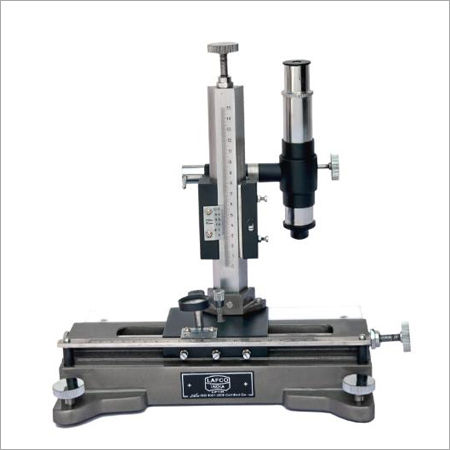
Tell us about your requirement

Price:
Quantity
Select Unit
- 50
- 100
- 200
- 250
- 500
- 1000+
Additional detail
Mobile number
Email

More Products in RESEARCH MICROSCOPE Category
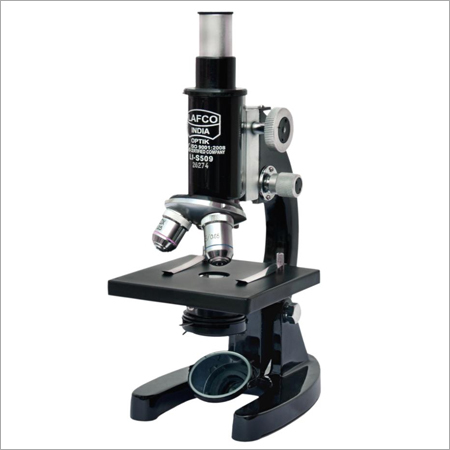
Student Microsocppe ISI
Price 1950 INR / Piece
Minimum Order Quantity : 1 Piece
Eyepieces : Widefield 10X and 15X (standard supplied)
Magnification : Up to 600X (with supplied objectives and eyepieces)
Theory : Other, Compound Optical Microscope for education and laboratory use
Light Source : Mirror (external light needed)
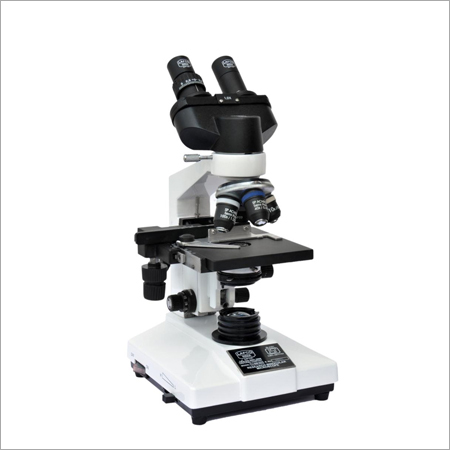
Research Binocular Microscope ISI
Eyepieces : Paired 10x or 15x wide field eyepieces.
Magnification : 40X to 1500X (Based on objective and eyepiece combo: typically 10x/15x eyepieces and 4x, 10x, 40x, 100x objectives).
Theory : Other, Compound optical microscope suitable for research applications with ISI certification.
Light Source : 6V20W halogen lamp with intensity control (or LED variant, as per model).
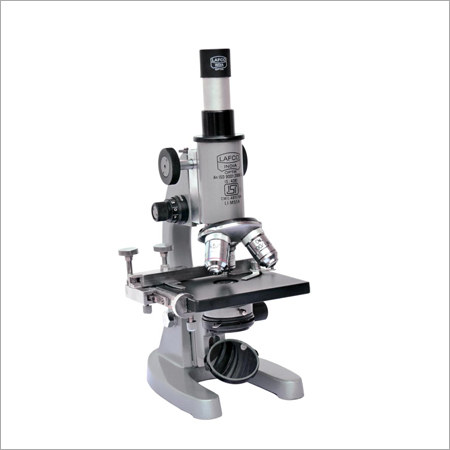
Senior Medical Microscope ISI
Price 2150 INR / Piece
Minimum Order Quantity : 1 Piece
Eyepieces : Wide field 10X/15X ISIcertified eyepieces
Magnification : Up to 400X (using 10X eyepiece and 40X objective)
Theory : Other, Senior Medical Microscope ISI is a laboratorygrade optical instrument designed for medical, clinical, and educational applications, featuring highprecision mechanical and optical components.
Light Source : Planoconcave mirror for reflected/transmitted light
Junior Medical Microscope ISI
Price 3900 INR
Minimum Order Quantity : 1 Unit
Eyepieces : 10x Wide field eyepiece
Magnification : 100x to 600x (approximate)
Theory : Biological Microscope
Light Source : Natural light or external illumination using a mirror

 Send Inquiry
Our Products
- RESEARCH MICROSCOPE
- LABORATORY INSTRUMENTS
- LABORATORY MICROSCOPE
- CHEMISRTY EQUIPMENTS
- OPTICAL BENCHES
- AUTOMATIC PROJECTORS
- HUMAN FIBRE MODELS
- BIOCHEMISTRY EQUIPMENTS
- BIOLOGY LAB EQUIPMENT
- DIGITAL THERMOMETER
- DIGITAL HYDROMETER
- ELECTRONICS ITEMS
- PHYSIOLOGY TESTS
- PHYSIC RESEARCH INSTRUMENTS
- SODA GLASSWARE
- BOROSILICATE GLASSWARE
- PHARMACY EQUIPMENTS & INSTRUMENTS
- Thermometer
- Microscope's Camera
- Microscope's software
- Histopathology
- Operating Microscopes
- Biotechnology Instruments
- Ophthalmic Equipment
- Molecular Biology
- D-Pharmacy Equipment
- Communication Lab Instruments
- Civil Engineering
- Chemistry
- Physics
- tuning fork
- Inverimental
- Hot Air Oven
- Mortuary Chamber

No.-3111/12, Cross Road No. 10, Kacha Bazar, Ambala Cantt - 133001, Haryana, India

Mr Anil Kumar Rana
(Proprietor)
Mobile :08045802246
 Send Inquiry
 Send SMS
Developed and Managed by Infocom Network Private Limited.
