
Call us now :08045802246
 Send Inquiry
 Send Inquiry
Tool Maker Microscope
Tool Maker Microscope Specification
- Spare Parts
- Replacement halogen lamp, eyepiece, objectives, fuse
- View Head
- Monocular, inclined
- Focus System
- Rack and pinion with precision drive
- Features
- Precision micrometer stage, rotary table, illumination for both transmitted and reflected light, robust metallic construction, adjustable stage supports, dust cover
- Theory
- A tool makers microscope is a precision measuring instrument designed for inspection, measurement, and calibration of small parts and tools under magnification.
- Drawtube
- Monocular drawtube
- Sensor
- Not applicable (visual optical instrument)
- Resolution
- Smallest reading up to 0.001 mm
- Interface
- Manual micrometer heads, no digital output
- Focal Distance
- 75 mm (standard working distance)
- Magnification
- Up to 50X (with combination of eyepiece and objective lens)
- Dimensions
- Approx. 350 mm (H) x 200 mm (W) x 300 mm (D)
- Focus Range
- Coarse & fine focusing adjustments provided
- Eyepieces
- Wide Field 10X
- Eyepiece Tube
- Inclined at 45 degrees, monocular head
- Illumination
- Reflected & transmitted halogen light
- Coarse Adjustment Range
- 30 mm
- Fine Adjustment Range
- 0.002 mm per division
- Working Stage
- 130 mm x 125 mm, rotary stage with micrometer slides; X-Y movement 25 mm in each direction
- Image Format
- Visual observation (no direct image capture, unless adapted for camera)
- Interpupillary Distance
- Fixed (monocular design)
- Objective Achromatic
- 2X and 10X standard objectives supplied
- Condenser
- Substage condenser provided for transmitted light
- Light Source
- Halogen lamp 6V/20W for illumination
- Micrometer Range
- 25 mm X and Y directions
- Weight
- Approx. 18 kg
- Power Supply
- 220V/110V AC, 50/60 Hz
- Application
- Suitable for dimensional measurement, tool angle measurement, gauge setting, PCB inspection
- Material
- Heavy cast iron base with enamel finish
- Accuracy
- 0.003 mm
- Accessories Included
- Glass scale, calibration certificate, instruction manual
- Stage Vernier Reading
- 0.001 mm vernier least count
- Stage Movement
- Fine movements with micrometer heads on X and Y axes
- Rotary Stage Graduation
- Graduated 360, least count 6 minutes
- Stage Surface
- Hard chrome plated, fitted with glass insert for transmitted light observation
About Tool Maker Microscope
SPECIFICATIONS
TOOL MAKER MICROSCOPE
Toolmaker microscopes are satisfies the increasing industrial requirements on measurements. The well designed basic unit with long working distance objectives, wide field eye pieces and a telecentric illumination system has been engineered for long period comfortable operation. It is an ideal instrument for simplifying inspection of forming tools, gauges-template checking, thread inspection verification of tool angles etc.
- Observation Tube - Monocular, Inclined at 30 Coupled with graduated Eyepiece Protractor.
- Base - Large and heavy base provides extra overall rigidity to the instrument.
- Stage - 152mm X 152mm size assembled on ball bearing guides to provide accurate and smooth stage stroke up to 50mm in each direction.
- Illumination - Sub-stage lamp emits transmitted light from a bottom source equipped with collimated green filter halogen light. Oblique illuminator with adjustable inclination for surface illumination of sample with relief structure is also provided. Three separate knobs for different illumination are provided with variable light control on the front panel.
- Objective - 2x Achromatic Eyepiece - WF 15 x with Cross reticle.
- Accessories - Different optional accessories are available.
Exceptional Precision for Industrial Measurement
Engineered for dimensional and angular assessments, the Tool Maker Microscope offers a vernier least count of 0.001 mm and rotary stage graduation to 6 minutes. The robust cast iron base and heavy-duty stage ensure reliable, repeatable measurements, ideal for tool makers, manufacturers, and PCB inspectors. The instrument is equipped with both coarse and fine focus adjustments for enhanced usability.
Versatile Observation and Measurement Features
The monocular drawtube, wide field 10X eyepiece, and supplied 2X and 10X achromatic objectives allow flexible magnification up to 50X. The hard-chrome plated rotary stage supports both reflected and transmitted illumination, with a glass insert for light transparency. The microscope is tailored to applications demanding high accuracy and meticulous inspection procedures.
Designed for Ease of Use and Durability
Construction uses premium materials, including a heavy cast iron base and dust cover for protection. Adjustable supports and a precision rack and pinion focus system promote user comfort. Supplied accessories, calibration certificate, and spare parts make setup and maintenance straightforward, while manual controls ensure effortless operation without complex interfaces.
FAQs of Tool Maker Microscope:
Q: How do I operate the stage micrometer heads for dimensional measurement?
A: Simply adjust the X and Y micrometer heads to position your specimen on the stage. Both axes offer precise movement of 25 mm each, and the vernier scales display readings down to 0.001 mm, enabling accurate measurements along both directions.Q: What types of applications is this microscope suitable for?
A: This tool maker microscope excels in dimensional measurement, tool angle verification, gauge setting, calibration, and PCB inspection. Its precision and adaptability cater to manufacturers and inspectors across engineering, electronics, and metrology.Q: Where should the microscope be installed for optimal performance?
A: Install the microscope in a dust-free, stable laboratory or workshop environment with access to a standard 220V/110V AC power supply. Placing it on a vibration-free workbench enhances measurement accuracy and illumination stability.Q: When is it necessary to recalibrate the device?
A: Routine recalibration is recommended as part of periodic maintenance, especially after moving the instrument or before critical measurements. The included calibration certificate provides guidance on recalibration intervals and procedures.Q: What is the process for setting gauge or inspecting PCB components?
A: Place the gauge or PCB on the rotary stage, use transmitted or reflected light for optimal visibility, and adjust the monocular head and stage for focus. Fine positioning and measurement are achieved using the micrometer heads and vernier scales, ensuring detailed analysis of small components.Q: How does the rotary stage add value to measurements and inspection?
A: The 360 graduated rotary stage allows precise angular adjustments with a least count of 6 minutes, facilitating accurate tool angle measurements, alignment, and multi-directional inspection without repositioning the specimen.Q: What are the benefits of using transmitted and reflected illumination modes?
A: Transmitted light is advantageous for transparent specimens or fine PCB details seen through the glass-inserted stage, while reflected illumination highlights surface features for detailed inspection. Both modes afford flexibility to match diverse sample requirements.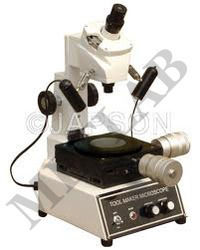
Tell us about your requirement

Price:
Quantity
Select Unit
- 50
- 100
- 200
- 250
- 500
- 1000+
Additional detail
Mobile number
Email

More Products in LABORATORY MICROSCOPE Category
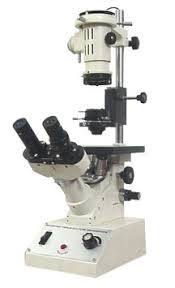
Trinocular Inverted Tissue Culture Microscope
Theory : Other, Inverted tissue culture microscope designed for observing living cells and tissues in culture, suitable for research and clinical laboratories.
View Head : Trinocular, inclined 45, 360 rotatable
Eyepieces : Paired WF10X/18mm (Wide Field)
Condenser : Condenser with variable aperture iris diaphragm, N.A. 0.4
Working Stage : Mechanical stage, size 210 x 240 mm with lowposition coaxial controls
Magnification : 40X to 400X (standard with 10X eyepiece and 4X, 10X, 20X, 40X objectives)
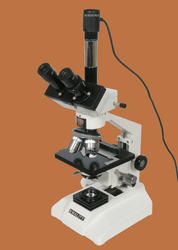
coaxial microscope with camera
Theory : Other, Optical theory with coaxial camera integration
View Head : Binocular with coaxial camera
Eyepieces : WF10/18 mm
Condenser : Abbe condenser NA=1.25 with iris diaphragm
Working Stage : Double layer mechanical stage with dimensions 125 mm 115 mm
Magnification : 401000
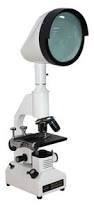
Projection Microscope
Theory : Other, Projection microscope
View Head : Projection screen head
Working Stage : Mechanical stage

 Send Inquiry
Our Products
- RESEARCH MICROSCOPE
- LABORATORY INSTRUMENTS
- LABORATORY MICROSCOPE
- CHEMISRTY EQUIPMENTS
- OPTICAL BENCHES
- AUTOMATIC PROJECTORS
- HUMAN FIBRE MODELS
- BIOCHEMISTRY EQUIPMENTS
- BIOLOGY LAB EQUIPMENT
- DIGITAL THERMOMETER
- DIGITAL HYDROMETER
- ELECTRONICS ITEMS
- PHYSIOLOGY TESTS
- PHYSIC RESEARCH INSTRUMENTS
- SODA GLASSWARE
- BOROSILICATE GLASSWARE
- PHARMACY EQUIPMENTS & INSTRUMENTS
- Thermometer
- Microscope's Camera
- Microscope's software
- Histopathology
- Operating Microscopes
- Biotechnology Instruments
- Ophthalmic Equipment
- Molecular Biology
- D-Pharmacy Equipment
- Communication Lab Instruments
- Civil Engineering
- Chemistry
- Physics
- tuning fork
- Inverimental
- Hot Air Oven
- Mortuary Chamber

No.-3111/12, Cross Road No. 10, Kacha Bazar, Ambala Cantt - 133001, Haryana, India

Mr Anil Kumar Rana
(Proprietor)
Mobile :08045802246
 Send Inquiry
 Send SMS
Developed and Managed by Infocom Network Private Limited.
